Performance creative: the future of paid social strategy
Yasmin Shakes • 24th Nov 2026
Performance creative is the intentional and structured use of creative diversity and creative strategy as part of media buying. It sits between strategy, psychology and production. After the introduction of Andromeda, performance creative is essential to paid social strategy.
Andromeda is the ad retrieval engine introduced by Meta, which changed the way the ad platforms work behind the scenes, dictating the need for media buyers and creatives to change the way they use Meta. In short, the advanced AI system filters millions of ad candidates to ultimately deliver more personalised ads to viewers.
It’s now been a year since Andromeda officially rolled out globally (Oct 2025). With the implementation of Andromeda, and particularly in the past year, the key shift is a focus on creative-first targeting.
Creative is the new targeting
Meta no longer primarily matches audiences to campaigns. Instead, it increasingly matches individuals to creative signals. Historically, a media buyer would select age, demographic, interests and more to narrow potential audiences down to the most relevant one for their ad. While these targeting features somewhat remain, the creative itself provides a more important signal to Meta to find the right viewer.
This means that creative diversity and creative strategy are now a core media buying function. Media buyers can’t overlook creative when considering how to target their audiences. We need to conduct research to understand our core audience, utilising this to create definitive concepts, which then inform our creative output.
Take for example, an ad for deodorant aimed at young female athletes. Meta relies on the creative providing key attributes to correctly categorise the ad and find the relevant viewer. For example, a video that shows a young woman, playing football, talking about her need for long-lasting deodorant. The script and supporting creative text speak directly to the target audience, addressing a pain point, and outlining their product as the solution.
Volume vs diversity
In order to produce winning ads, brands need to find the right balance between volume and diversity of creative. A winning ad is usually the result of structured exploration, not luck.
A winning ad is an ad that reaches a statistical threshold of significant budget, aka spends at least 10x its account median. According to Motion, only 4-10% of ads are winners, and this percentage changes as you scale. Winning ads soak up the majority of the budget, while effectively achieving account KPIs. By mathematical logic, launching more ads will increase your number of winners, but only to a point. Brands should launch ads at a rate that works with their budget, ensuring that each ad has a chance to learn effectively and be categorised as a winner or loser.
On a personal note, as a media buyer and performance creative strategist, sometimes we have to separate our feelings from performance. I have worked on a number of ads, in which the output looks great, and research has informed me it has a chance of being a winner, only for it to be outperformed by another ad. The harsh reality check is that time and effort will be poured into ads that will become losers. However, it’s what we learn from them that is crucial to moving forward and informing the next strategic steps. We need losers in order to have winners and scale accounts.

Creative is the new targeting: Meta is increasingly matching people to creative signals rather than relying primarily on demographic or interest-based targeting.
Meaningful variation, not minor tweaks
Meta rewards creative diversity, and not in the traditional way we used to think. Previously, changing the background colour, swapping the headline or using a different soundtrack counted as a ‘new’ and therefore diverse ad. Now, this isn’t sufficient to be considered diverse enough from Meta’s POV. Diversity comes from intentional differences to creative. Diverse creative includes testing creative formats, messaging angles, content pillars, production styles and more. The goal is for Meta (Andromeda) to scan your bank of creative, and process different creative that can reach different audiences.
Not all deodorant-needing female athletes will respond the same to a UGC customer testimonial style video, some may better interact with a static image that outlines how and why the formula of this deodorant will work for them. If a brand only provided the UGC style video, it would potentially be missing out on an entire audience of potential buyers who resonate with scientific product demonstrations in order to inform their purchasing habits. And vice versa for if a brand only provided a static image which has no social proof from existing customers.
My top tip for helping a brand understand if their creative is diverse is to put yourself in Andromeda’s shoes. Imagine all your assets are laid out in a collage in front of you, then blur your eyes. Does the blur make them blend in and look the same (e.g. all a fuzz of text on a blue background)? Or within the blur, can you make out some text, some faces, some products, some movement from videos? This is how Meta scans.
For example, this could include casting a new creator (e.g. older male) to recreate a winning ad previously performed by a younger woman, unlocking a new audience that may not have been reached by the original creator.
Operational cycle
Performance creative as an operational process is a loop, each stage feeds into the next. The input, resources and team role required at each stage vary. This is also where it becomes clear that the role of the media buyer is becoming more creative, and the role of the creative strategist is becoming more analytical.
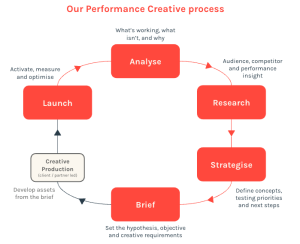
The brands that successfully utilise performance creative can unlock growth for their paid channels, but it doesn’t happen overnight. And it’s not just a flick of a switch to “get more creative”. The brands that scale are the ones that can operationalise learning. At each step of the process, brands should build on insights from both an operational and performance point of view.
Creative analysis helps us be critical of the creative, and use the numbers to inform decisions. Brands need to learn how to scale winning ads effectively, and learn from losing ads. To let the ad performance dictate what to brief next, while being mindful of gaps in creative that are yet to be tested.

A winning ad is usually the result of structured exploration, not luck.
Conclusion
So, what does good performance creative look like?
For me, it’s about a deep understanding of our ad platforms, knowing what levers to pull to make the platforms work as hard as they can for us, and building a repeatable learning system to execute that.
Quick wins:
- Know which audience motivation or problem each creative is addressing.
- Create genuinely different creative (through various concepts), not just minor cosmetic variations.
- Use performance data to decide what to iterate and understand why.
- Keep research connected to briefing and production.
- Make creative and media teams part of the same feedback loop.
The platforms will keep evolving, with specific delivery systems, placements and optimisation features updating constantly. But the underlying advantage stays similar: understand the customer better, turn that understanding into distinctive creative, and build a system that gets smarter every time you run it.
Contact Us
Give us a call, or complete the form. We’ll put the kettle on and by the time you get here we’ll already be thinking about your business.